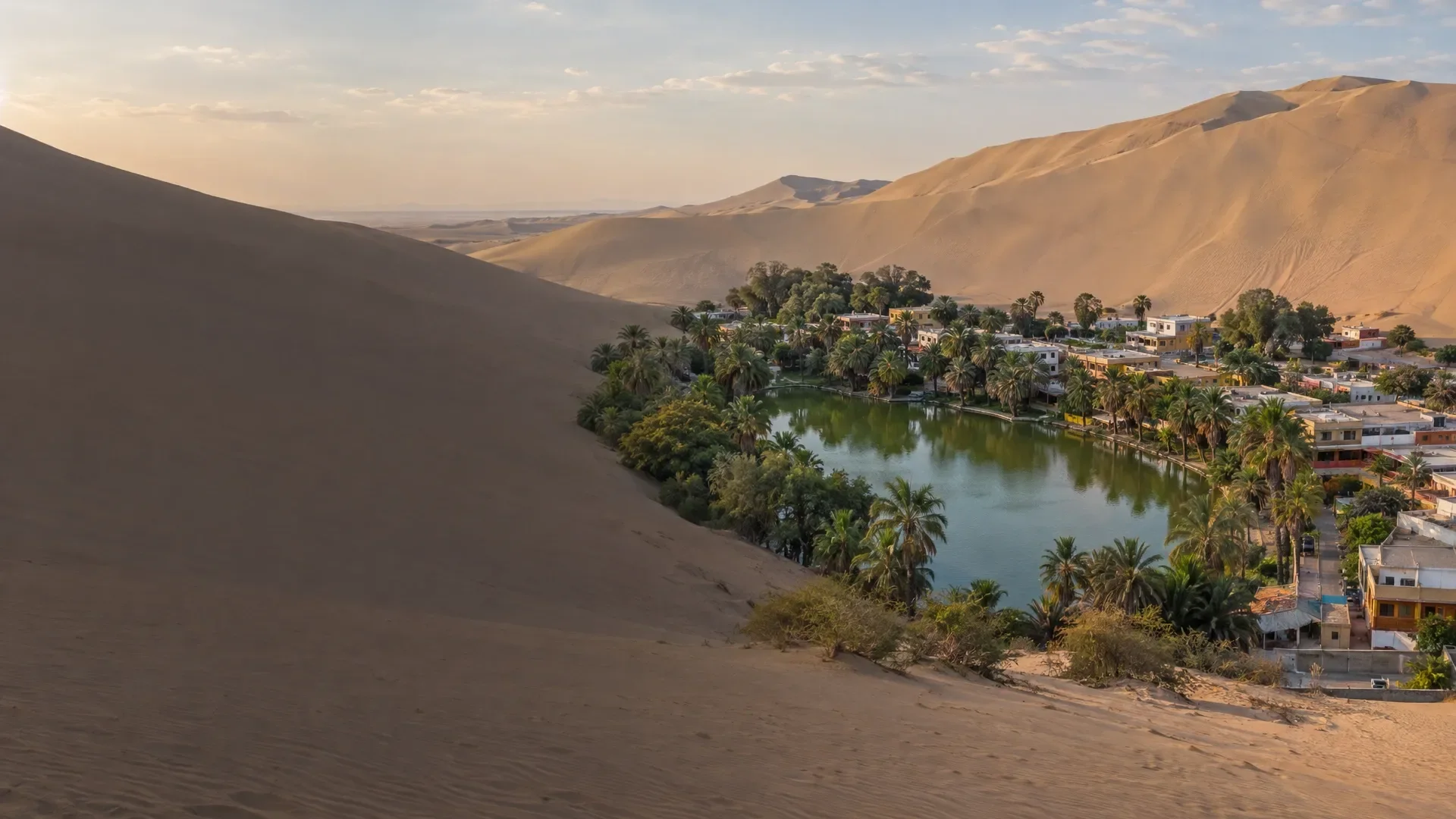
Huacachina is small enough to circle quickly: a lagoon, palms, hotels and restaurants with steep sand slopes immediately behind them. The contrast is real, but this is not a remote desert village. Ica sits close by, and the water and surrounding landscape are managed within a regional conservation area.
By day, visitors gather around activities and terraces; towards late afternoon many visitors climb for the oasis view. An overnight stay suits travellers who want that scene without watching the clock. Those seeking quiet should know that engines and nightlife are part of the destination as it operates today.
The lagoon and its protected setting
Huacachina and its surrounding dunes have formed an Área de Conservación Regional since 2014. Protection covers not only the familiar water and palms but also desert landscape and archaeological values. A lap of the lagoon provides quick orientation; the larger scale becomes clear only after climbing far enough to see Ica behind the dunes.
Walking into the dunes
Walking is the simplest way to experience the landscape at your own pace. Loose sand makes a short climb harder than its distance suggests, and shade is scarce around midday. Ask locally which walking path to use, keep clear of tubular-vehicle tracks and return before full darkness if the terrain is unfamiliar.
Tubulares and sandboarding
The open off-road vehicles known locally as tubulares travel farther into the dune field and often combine the ride with board descents. This is a motorised attraction, not a quiet landscape visit. Ask which vehicle will be used, who drives it, what restraints and protective equipment are provided, and what route and group size are planned.
Following serious incidents, Peruvian authorities placed renewed emphasis in 2025 and 2026 on informal vehicles, municipal authorisation and a reseller’s responsibility to inspect subcontracted services. A desk inside a hostel is therefore not evidence of permission. Ask who actually operates the ride, identify the vehicle and request current authorisation.
Board or skis
Recreational trips often use basic boards that beginners descend seated or prone; standing sandboarding or sand skiing requires different equipment and more technique. Ask what is included before booking. Tell the guide about your experience and ask which slope and equipment would suit you.
What happens at lagoon level
Everything around the lagoon sits close together. That is convenient for a short stop, but most businesses cater directly to visitors. Head into Ica for the regional museum, city markets, more everyday lunch places or a wider hotel range. Huacachina itself revolves around water, slopes and social evenings.
Eating around the oasis
Lagoon restaurants serve many international traveller staples alongside Peruvian classics. For a taste of the region, try pallares, carapulcra or a teja with your coffee. Ica is usually better for wider local choice and simple daily menus; a short taxi ride changes the selection substantially.
Part of a day or overnight
Part of a day covers a lagoon circuit, a dune climb and late-afternoon views. Staying overnight removes transport pressure before sunset and also allows an early, cooler walk. Two nights mainly make sense when Huacachina is your base for Ica or a pisco route as well.
Huacachina is not an intercity hub
Long-distance buses normally leave from Ica. There is no single universal station there: companies may use their own terminals or offices. From Huacachina, ask to be taken to the precise address printed on your ticket and allow for city traffic. This matters especially when continuing south to Nazca.
Places to stay in Huacachina
Compare the locations of places to stay in and around Huacachina.
Where is it?
Huacachina and the surrounding area.