South of Cusco are lakes surrounded by farmland, villages with their own history and the deep Apurímac gorge. Waqrapukara rises like a rocky stronghold; at Q’eswachaka, communities keep bridge-weaving knowledge alive. The name Cusco Alto Andino brings together attractions in Canas and Acomayo. Choose your outing for what you want to experience: lakes and villages, the story of the rope bridge or a walk to an archaeological site.

Where is it in relation to Cusco?
Canas and Acomayo lie in the southern part of the Cusco region. They are not part of the Sacred Valley around Pisac and Ollantaytambo. The Four Lagoons form their own group; Waqrapukara is in Acos district, Acomayo, and Q’eswachaka in Quehue, Canas. Langui-Layo lies separately, beside the villages sharing its name. For that lake, the tourism inventory describes an approach from Cusco via Sicuani and Langui. Staying at one hotel in Cusco does not mean all these places are close together.
In July 2026, GERCETUR presented the shared destination name and identified Waqrapukara, Q’eswachaka and the Four Lagoons as major attractions. The name helps you look beyond familiar Cusco excursions. Compare which stops, walking sections and admission tickets each operator includes in its programme.
Four Lagoons: make time for shores and villages
The Circuito de las Cuatro Lagunas comprises Pomacanchi, Acopia, Asnaqocha and Pampamarca. Their surroundings give each a different character. Pomacanchi lies among grasslands; smaller Acopia is beside its namesake village. Totora reeds grow around Pampamarca. Allow time to watch from a suitable spot on the shore rather than only stepping out of the car at each lake. Binoculars give you more opportunities to watch birds on the water.
If you mainly want a day outdoors without a major hike as the focus, start with a proposal for the lakes and one village. Establish where you actually stop and have lunch. A circuit of all four can still consist largely of driving; the length of the stops makes the difference. Walking along a chosen stretch of shore and eating in the village creates a different rhythm from a programme that continues to another distant attraction that day.
Tungasuca: history among the landscapes
In Tungasuca, in Canas's Túpac Amaru district, stands the house associated with José Gabriel Condorcanqui, Túpac Amaru II. The Ministry of Culture recognised the building as national heritage and links it to the rebellion he led in 1780. It adds a historical subject beyond the Incas to your outing. If that interests you, include Tungasuca in a proposal for the area. Arrange any interior visit separately; heritage designation does not establish that a museum opens there daily.
Q’eswachaka: a bridge made anew
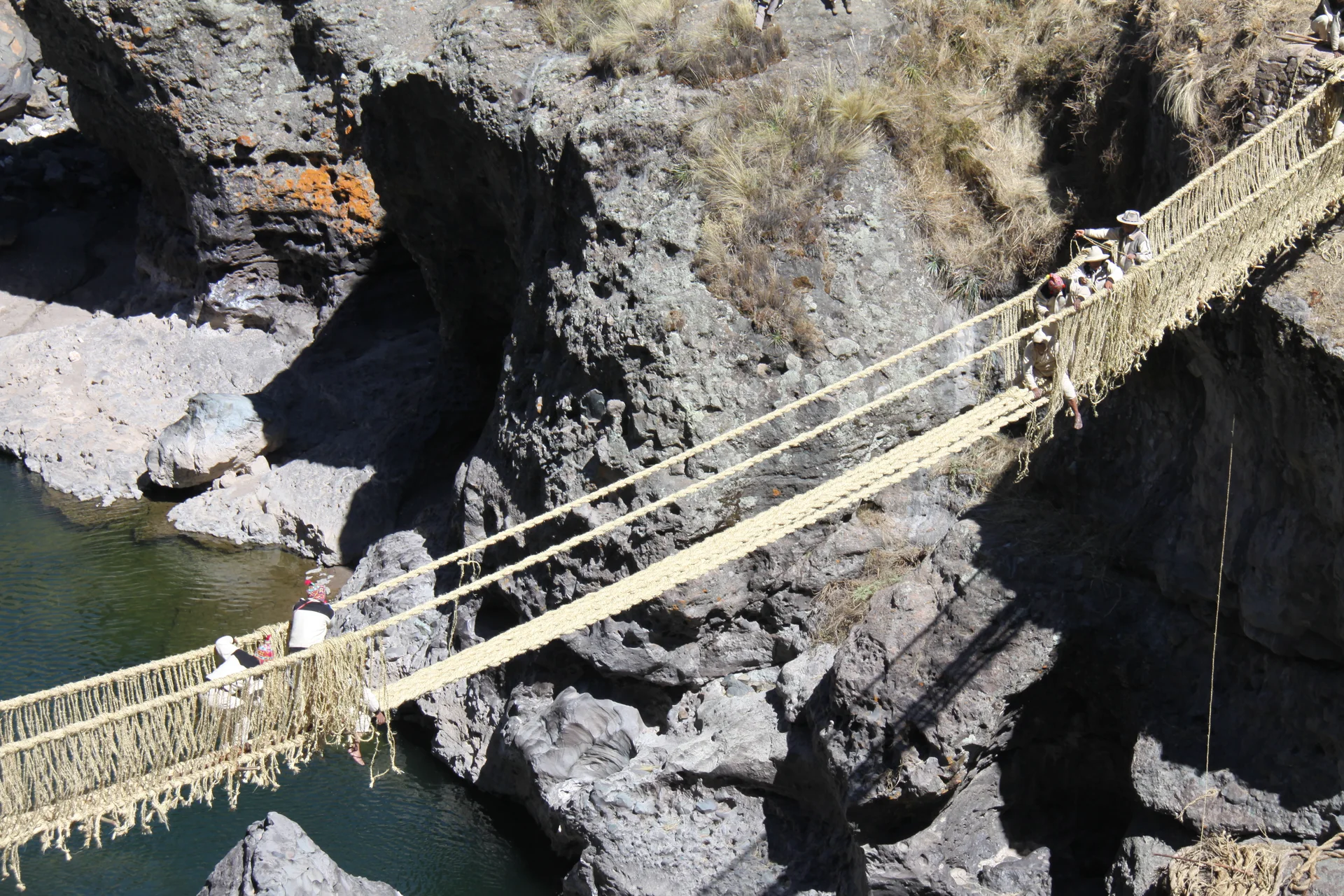
Near Quehue, Q’eswachaka connects the banks of the Apurímac with braided plant fibres. The communities renew the bridge using inherited techniques. Weaving knowledge passes between generations; it is the knowledge and rituals surrounding the annual renewal that have been on UNESCO's intangible heritage list since 2013. Look at the ropes, their anchoring beside the rock faces and the scale of the gorge. They help you appreciate the work involved in making the span.
Visiting the bridge and attending its renewal are different plans. The tradition is associated with June, but attending a particular edition requires the programme and guidance from the organising communities. Outside that period too, confirm what can be visited before setting out. Treat crossing as a separate possibility dependent on current conditions and local instructions, rather than building the whole outing around that one action.
Waqrapukara: rock formations, terraces and a walk
Waqrapukara occupies a rock formation in Acos, Acomayo. Building remains with passages and niches occupy the upper part; terraces below follow the shape of the terrain. Natural rock forms part of the construction, with walls along the steep edge. Cusco's heritage authority suggests a ceremonial function. There is more to see than the distinctive silhouette: how the builders used the available rock and space is central to the site.
Treat Waqrapukara as a walking excursion with a road approach. The official inventory describes a drive on the Acos side followed by a path to the site. The destination name alone does not identify where you leave the vehicle or how far you walk. Establish the chosen trailhead, outward and return walk, and pickup point. Allow time at the site itself; if Waqrapukara is your priority, choose the other stops around that walk.
Langui-Layo and Pallay Punchu are a different choice
Langui-Layo is not one of the Four Lagoons. It is a separate lake between the districts of Langui and Layo, with totora along sections of shore and waterbirds. You can focus a visit on the lake landscape and a stop in one of the villages. For a walk, Pallay Punchu is another option to investigate: it has coloured bands of rock and views towards Langui-Layo. The tourism inventory places it between Layo in Canas and Marangani in Canchis province. That distinction helps when comparing approaches.
For Pallay Punchu, establish the side of the mountain and exact walking start. An offer via Layo is not automatically the same as an approach through Marangani. It is a mountain outing; consider the elevation profile and complete walk separately from the drive beside the lake. Do not treat the coloured ridge as an automatic extra on a lake circuit. Choosing the lake without the mountain walk leaves more time by the water and in the villages.
Turn your interests into a specific proposal
For lakes and village life, start with the Four Lagoons and time for a chosen village and lunch. For heritage and engineering, centre the outing on Q’eswachaka and then select suitable stops along the way. For archaeology and walking, make Waqrapukara the main activity. Langui-Layo and Pallay Punchu warrant a separate choice around Sicuani, Langui or Marangani. Have the operator include the full outward and return journey in the proposal.
Returning to Cusco keeps your accommodation arrangements simple. If you want to see several parts of the area, compare that with a night nearer your next visit. First confirm the actual accommodation and next pickup. Meals are part of this: lunch in Pomacanchi or a lakeside village needs different planning from taking a meal on the Waqrapukara walk. Establish where you eat, what is carried and where your luggage stays. A local overnight stay does not automatically shorten every onward connection.
Shortly before departure, confirm the chosen road, walking access and local visiting arrangements. This matters especially when a programme changes its usual approach or combines several places. Save your stop names offline and agree on the return or finishing point. With a clear main visit, you can take time for the water, stonework or bridge-building that brought you here.