.jpg)
Trujillo has colourful façades and a long history behind its front doors. Grand houses from the colonial and republican periods surround the Plaza de Armas. Beyond the city lies the dry northern coast, home to Chan Chan’s earthen walls and the temples of Moche. Three quite different settings sit close together.
It is an engaging place to get to know northern Peru. A town house reveals how wealthy families lived; the huacas show the imagery through which priests expressed their power. Fish and hearty northern soups share the menu. Northwest of the city, Huanchaco offers a trip to the sea or a coastal place to stay.
Behind the city’s façades
The Plaza de Armas makes a useful starting point. Follow the streets around Jirón Pizarro and look at the large doors and windows of the casonas. These houses reflect several periods: colonial construction, followed by alterations as families adapted their homes to changing tastes.
MUCEN Trujillo, inside Casa Urquiaga at Pizarro 446, offers a closer look. Three courtyards form part of the house’s layout. Collections range from pre-Columbian pottery to paintings, tableware and furniture from later centuries. Domestic rooms matter too: the dining room and bedroom introduce the lives of the people who lived here. They bring the grand exterior down to a more personal scale.
Casa de la Emancipación is recognisable by its wrought-iron windows. It played a role in the early republic, housing Congress and Riva Agüero’s government in 1823. Include its exterior on a walk; Fundación BBVA, which manages the property, currently reports that it is closed to the public.
Chan Chan: an earthen capital
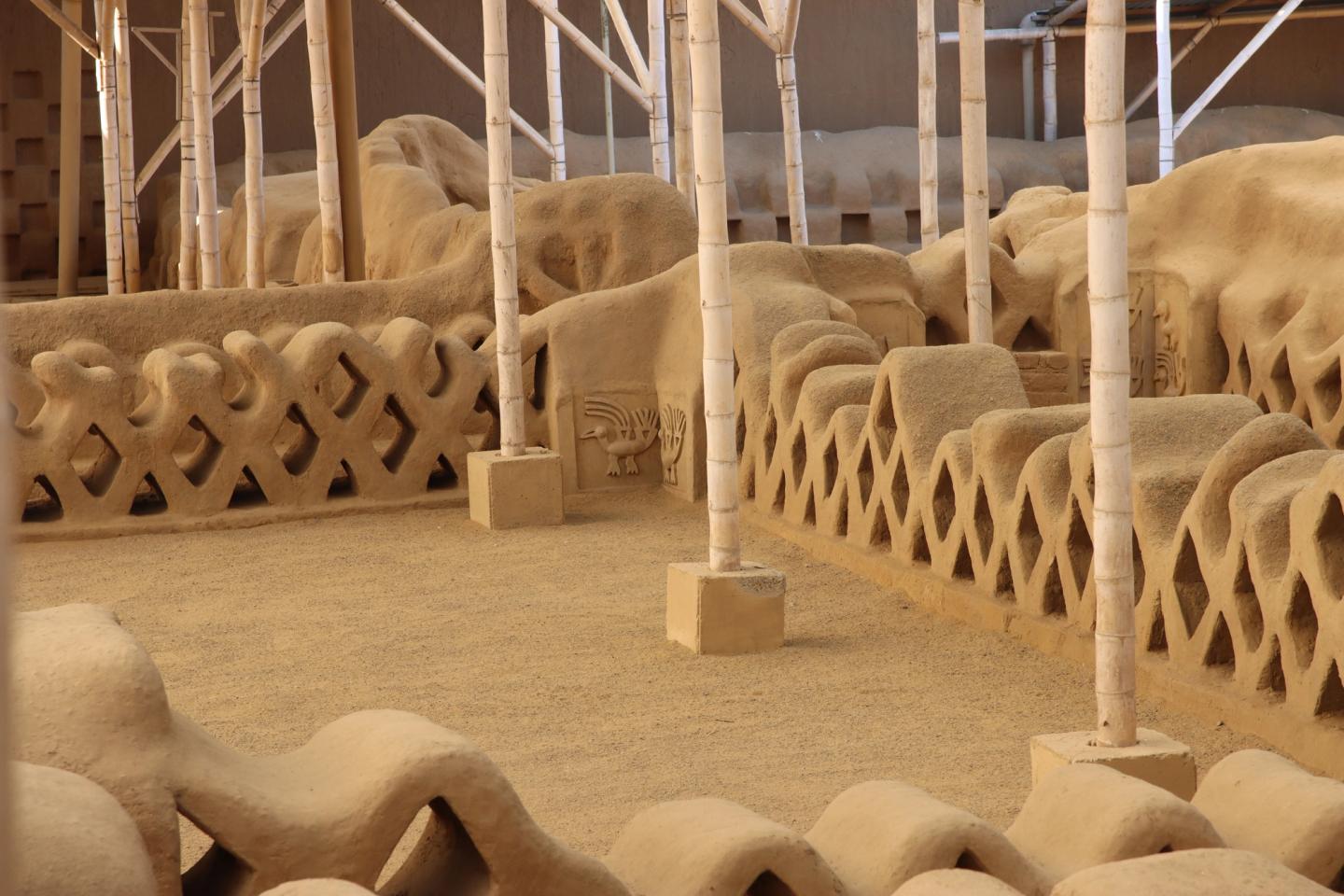
Chan Chan was the capital of the Chimú kingdom. Tall earthen walls enclosed palace compounds with plazas, storage spaces and reservoirs. Reliefs and the sequence of open and enclosed spaces shape the visit. This is a place to consider how a large city worked: who lived and worked where, and who had access. The Moche temples tell a different story.
Huaca de la Luna: colour and ritual
The Huacas de Moche stand beside Cerro Blanco. Huaca de la Luna has painted reliefs depicting deities, warriors and prisoners; the temple complex opens a window onto Moche religious life. Human sacrifice forms part of the interpretation. Huaca del Sol is the complex’s other large adobe structure.
A city with streets, homes and workshops lay between the two huacas. Excavated objects at the Museo Santiago Uceda Castillo add context. The archaeological project publishes separate admission for Huaca de la Luna and the museum. The combined name ‘Sol y Luna’ does not mean a tour takes you inside both temples.
Soup, fish and a leisurely lunch
Shámbar is a substantial soup with pulses and meat; sopa teóloga is made with turkey. Both belong to northern cooking and give you a reason to try an unfamiliar dish at lunch. Along the coast, ceviche and sudado are familiar choices: citrus-marinated fish and a hot cooked fish dish respectively.
Big Ben California is a specific city address for northern cooking: Los Geranios 263, in California neighbourhood. It sits outside a walk around the Plaza de Armas. The restaurant also has a Huanchaco branch, so choose the address that fits where you will be.
Stay in Trujillo or Huanchaco?
Choose Trujillo if you want historic streets and museums close to your accommodation. Huanchaco suits a stay with more time by the sea or taking surf lessons. Chan Chan and the Huacas de Moche require transport from either base and lie in different directions. For a booked excursion, ask for the actual sites included, particularly the museum and Huaca de la Luna. That makes it clearer how your time on site will be spent.
Places to stay in Trujillo
Compare the locations of places to stay in and around Trujillo.
Where is it?
Trujillo and the surrounding area.